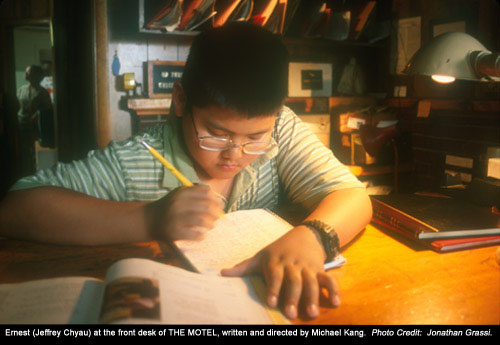
Thirteen-year-old Ernest Chin lives and works at a sleazy hourly-rate motel on a strip of desolate suburban bi-way. Misunderstood by his family and blindly careening into puberty, Ernest befriends Sam Kim, a self-destructive yet charismatic Korean man who has checked in. Sam teaches the fatherless boy all the rites of manhood.
|
|
Thirteen-year-old Ernest lives and works at a sleazy hourly-rate motel on a strip of desolate suburban bi-way with his Mother, his Grandfather and his little sister. This is the family business. Even though he's only thirteen, Ernest has to take on the responsibilities of man of the house since his father has abandoned the family. After school, Ernest cleans all the vacant rooms making sure to sponge off the wet spots on the plastic-sheeted mattresses. He also baby sits his eight-year-old sister Katie whose playground is the parking lot and favorite toy is a dirt-filled headless Barbie. And at night, Ernest watches the front desk making sure that guests pay for their three-hour check-ins. Ernest's Mother is a battleaxe of a woman -- running her own business and raising two children makes it hard not to be. When she finds out that her son has lied to her about entering and also winning a short story contest, her punishment to him is to regard the whole matter as a waste of time. In her mind, he wasn’t even good enough to win anyway; he only got Honorable Mention. Underneath her anger lies the fear that Ernest may actually be growing into an individual. Ernest’s only solace from life at the motel comes in the form of a fifteen-year-old girl named Christine whose family owns the Chinese restaurant down the street. Ernest loves Christine. Christine thinks Ernest is a dork. And then Sam Kim checks in. Sam, a charismatic Korean American man who has his whole life packed in the trunk of his car, has come to the motel to sleep with as many ethnically diverse prostitutes as possible and hopefully to forget about the crumbling life he left behind. Sam sees himself in Ernest, a boy lost in the worst stages of pre-pubescence with nobody to help guide him. After they bond over a midnight snack of fried chicken, Sam becomes inspired to take Ernest under his wing and teach him the steps to manhood.. |
|
|
|
I have always been fascinated with the idea of rites of passage in contemporary America. I created the character of Sam Kim out of the idea of what kind of knowledge I could impart to a boy who was on the road to manhood. I realized that if I had the opportunity to teach a child, I wouldn't do any better than the completely dysfunctional and misguided Sam Kim. The central struggle between Ernest and his mother Ahma revolving around a story Ernest has written came from wanting to show how not only is it a burgeoning manhood that threatens the relationship between child and parent, but the idea of a child truly expressing oneself. The reality of Ernest becoming a full person separate from his mother is the most threatening aspect of their struggle. Ultimately, both his mother and he just want to be loved but neither is equipped to give it. My goal in the direction was to maintain a sense of intimacy while giving the story an epic quality. I look to films like “400 Blows” or “My Life As A Dog” as models for this tone. This perspective mirrors the way life feels at thirteen – everything is mythic in its proportions. Though this is an “Asian American” film, I think what was always most important to me was the idea that the narrative had to be solid in its craft. I have seen too many "ethnic” films that become didactic or forsake story for politics (or worse the story is the politics!). “The Motel” strives for a similar aesthetic and balance as films like “Star Maps” and “Smoke Signals.” Though the film is unapologetically culturally specific, it is only as successful as it is rooted in showing complex characters and telling a complete story. Most important to me in making this film is to maintain the sense of humor of the story. I have always found humor the most effective way to get a point across. In “The Motel,” the delicate balance in the crafting of the comedy comes from having the humor directly connected to the humanity and vulnerability of the characters. Hopefully, by using comedy, I can gently push the audience to uncomfortable areas they had not anticipated and discover things about themselves. |
 SHORT SYNOPSIS:
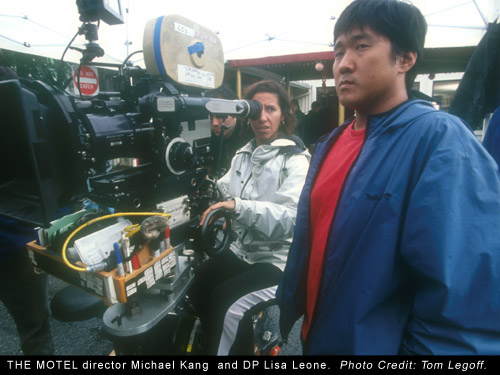 I made “The Motel” to explore that awkward age when puberty kicks in and suddenly everything has a charged sexual undercurrent. The inspiration for the setting came when I asked myself where would be the worst possible place to put a boy at that age? The answer -- surrounded by the darkest crevices of the world of sex, a sleazy hourly-rate motel. My own awful memories of adolescence were embodied in the character of Ernest, a chubby thirteen-year-old kid with hormones running out of control.